

명성황후
The Last Empress (명성황후) is a large-scale Korean original musical depicting the life and assassination of Empress Myeongseong amid late Joseon political turmoil and foreign intervention. It is widely regarded as a foundational work in the development of Korea’s modern musical theatre industry.
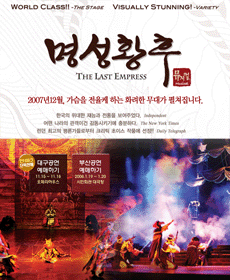
Posters included in this archive are embedded solely for documentary and educational purposes.
🔗 All images are linked to their original sources or articles. No copyright ownership is claimed.
SOURCE
biography
SETTING
Korea
BOOK
original
Productions in Korea
1995.12 🔴 Seoul Arts Center Opera House (Seoul)
1996.04 🔴 Seoul Arts Center Opera House (Seoul)
1998.02 🔴 Seoul Arts Center Opera House (Seoul)
1999.10 🔴 Seoul Arts Center Opera House (Seoul)
2000.02 🔴 Seoul Arts Center Opera House (Seoul)
2000.12 🔴 Seoul Arts Center Opera House (Seoul)
2002.03 🔴 Seoul Arts Center Opera House (Seoul)
2003.09 🔴 Seoul Arts Center Opera House (Seoul)
2003.11 🔴 National Theater of Korea, Haeoreum Theater (Seoul)
2005.02 🔴 Seoul Arts Center Opera House (Seoul)
2006.03 🔴 Seoul Arts Center Opera House (Seoul)
2006.12 🔴 National Theater of Korea, Haeoreum Theater (Seoul)
2007.02 🔴 Seoul Arts Center Opera House (Seoul)
2007.12 🔴 National Theater of Korea, Haeoreum Theater (Seoul)
2009.11 🔴 National Theater of Korea, Haeoreum Theater (Seoul)
2011.10 🔴 Chungmu Art Center Grand Theater (Seoul)
2015.07 🔴 Seoul Arts Center Opera House (Seoul)
2018.03 🔴 Sejong Center Grand Theater (Seoul)
2021.01 🔴 Seoul Arts Center Opera House (Seoul)
2025.01 🔴 Sejong Center Grand Theater (Seoul)
🔴 = Seoul Large Theatre Production
SYNOPSIS
(Full Synopsis)
Set in the late 19th century during the final years of the Joseon Dynasty, the musical unfolds across the royal court and international political arena, where Empress Myeongseong struggles to preserve national sovereignty amid foreign intervention and internal power conflicts.
The story opens with a courtroom in Hiroshima in 1896, where those accused of assassinating the Empress are tried. The narrative then moves back to her early life as Min Ja-young, who is chosen to marry King Gojong under the influence of the regent Heungseon Daewongun. As Gojong matures and asserts royal authority, tensions rise between him and the Daewongun, while the Queen gains political influence within the court.
Amid increasing instability, including factional strife and the Imo Military Revolt, the Queen navigates alliances with foreign powers, particularly Qing China, to maintain control. However, Japan’s growing influence in Korea leads to escalating hostility. Viewing the Queen as a political obstacle, Japanese agents orchestrate a covert assassination plot known as “Fox Hunt.”
The musical culminates in the assassination of Empress Myeongseong during the Eulmi Incident. In its final moments, the narrative reflects on her legacy and the enduring spirit of the Korean people, often represented through symbolic reappearances of the Empress and collective choral expression.
PRODUCTION NOTE
The Last Empress premiered in December 1995 at the Seoul Arts Center, marking the 100th anniversary of the assassination of Empress Myeongseong. Based on Yi Mun-yol’s play The Fox Hunt, it was adapted by playwright Kim Kwang-lim, with music by Kim Hee-gap and lyrics by Yang In-ja. Directed by Yoon Ho-jin and produced by A-Com, the musical became one of the earliest large-scale Korean original musicals.
It played a pivotal role in establishing the professional structure of Korean musical theatre, including the emergence of the musical music director role. The production achieved over one million cumulative attendees and became the first Korean musical to be staged in major Western venues, including Lincoln Center in New York (1997) and the West End in London (2002). Despite mixed critical reception abroad, it remains a landmark production in Korea’s musical theatre history.


REFERENCES
Synopsis Sources
NamuWiki Synopsis
https://namu.wiki/w/%EB%AA%85%EC%84%B1%ED%99%A9%ED%9B%84(%EB%AE%A4%EC%A7%80%EC%BB%AC)
The Musical Synopsis Page
https://www.themusical.co.kr/Musical/Detail?num=1788
Musicals of Korea Synopsis
https://www.musicalsofkorea.com/korean-original-musicals/202412_the-last-empress
Articles & Reviews
Wikipedia Overview
https://ko.wikipedia.org/wiki/%EB%AA%85%EC%84%B1%ED%99%A9%ED%9B%84_(%EB%AE%A4%EC%A7%80%EC%BB%AC)
English Wikipedia
https://en.wikipedia.org/wiki/The_Last_Empress_(musical)
Korea Herald Article
https://www.koreaherald.com/article/10412627
DongA Ilbo London Review
https://www.donga.com/news//article/all/20020203/7785035/9
JoongAng Review
https://www.joongang.co.kr/article/18432465
Related Pages (Musicals of Korea)
The Last Empress Review
https://www.musicalsofkorea.com/korean-original-musicals/202412_the-last-empress