top of page


파리의 연인
Lovers in Paris (파리의 연인) is a musical adaptation of the hit Korean TV drama, reinterpreting its Cinderella-style romance through a fast-paced narrative, original staging, and musically driven storytelling distinct from the source material.
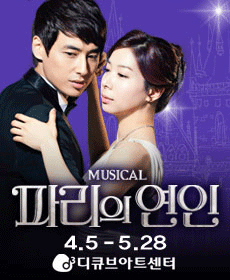
Posters included in this archive are embedded solely for documentary and educational purposes.
🔗 All images are linked to their original sources or articles. No copyright ownership is claimed.
SOURCE
drama
SETTING
Korea
BOOK
adaptation
Productions in Korea
2012.04 🔴 D-Cube Link Arts Center (Seoul)
🔴 = Large-scale production
SYNOPSIS
(Partial Synopsis)
Set in contemporary Korea and Paris-inspired settings, the musical unfolds around a romance between a wealthy heir and an ordinary woman, where class difference and emotional hesitation shape their relationship.
The story follows a classic Cinderella-style arc in which an independent female protagonist becomes involved with a powerful male lead, while a second male character creates emotional tension within a triangular relationship. Unlike the original drama, the musical compresses the narrative into a faster, stage-oriented structure, emphasizing emotional beats through songs and choreography rather than episodic storytelling.
While retaining the core romantic premise, the musical introduces new scenes and removes many iconic lines from the drama, instead focusing on internal conflict, social contrast, and romantic tension through musical numbers. The ending is also altered, distancing the work from its television origins and reinforcing its identity as a standalone stage production.
PRODUCTION NOTE
Lovers in Paris is based on the highly successful Korean television drama of the same name, which achieved peak ratings of over 50% and became a cultural phenomenon across Asia. The musical was developed over approximately two years and presented as a large-scale original production in 2012.
The adaptation was led by playwright Lee Hee-jun and director Gustavo Zajac, an internationally active creative known for works such as Man of La Mancha and Nine. The production intentionally diverged from the original drama, restructuring the narrative into a two-hour musical format with new scenes, revised characterizations, and a different ending. Emphasis was placed on choreography, spectacle, and musically driven storytelling, incorporating elements such as tango, can-can, and aerial performance.
The score, composed by Joy Son with musical direction by Koo So-young, was noted for its strong integration into dramatic structure, distinguishing the work from other drama-based musical adaptations.

REFERENCES
Synopsis Sources
PlayDB 작품 설명
https://m.playdb.co.kr/Play/Detail/32000
JoongAng Review
https://www.joongang.co.kr/article/8109988
Articles & Reviews
Channel YES Review
https://ch.yes24.com/article/details/70692
OhmyNews Article
https://star.ohmynews.com/NWS_Web/OhmyStar/at_pg.aspx?CNTN_CD=A0001711779
Channel YES Article
https://ch.yes24.com/Article/Details/19270
The Musical DB
bottom of page