

곤 투모로우
Gone Tomorrow (곤 투모로우) is a Korean original musical set during the late Joseon period, depicting revolution, political conflict, and personal conviction through a fictionalized narrative based on historical events.
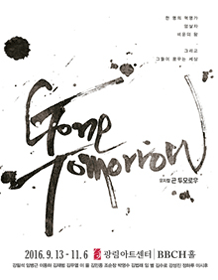
Posters included in this archive are embedded solely for documentary and educational purposes.
🔗 All images are linked to their original sources or articles. No copyright ownership is claimed.
SOURCE
history
SETTING
Korea
BOOK
original
Productions in Korea
2016.09 🔴 Kwanglim Art Center BBCH Hall (Seoul)
2021.12 Hongik University Daehangno Art Center Grand Theater (Seoul)
2023.08 🔴 Kwanglim Art Center BBCH Hall (Seoul)
2026.09 Hongik University Daehangno Art Center Grand Theater (Seoul)
🔴 = Large-scale production
SYNOPSIS
(Full Synopsis)
Set in late 19th-century Joseon during a period of political turmoil, the musical unfolds around the failed Gapsin Coup and its aftermath, where ideals of reform clash with betrayal and survival.
Kim Okkyun, a reformist intellectual, leads an uprising with the support of King Gojong to modernize the nation. However, the coup collapses within three days due to foreign intervention and political betrayal, forcing him into exile in Japan.
Years later, Han Jeong-hoon, who once left Joseon and lived abroad, is summoned back under the alias Hong Jong-u and ordered to assassinate Kim. Though initially driven by ambition and duty, Han begins to question his mission after meeting Kim and witnessing his unwavering ideals.
As political tensions intensify, King Gojong becomes increasingly unstable under pressure, while competing powers manipulate events behind the scenes. Han struggles between obedience and personal conviction, ultimately confronting the meaning of loyalty and revolution.
In the final encounter, Han carries out the assassination, but the act becomes a tragic culmination of conflicting visions of the future, leaving behind a legacy of unresolved ideals and sacrifice.
PRODUCTION NOTE
Gone Tomorrow premiered in 2016 at Kwanglim Art Center BBCH Hall, based on a dramatic adaptation of historical events surrounding the Gapsin Coup. The work incorporates fictional characters alongside real historical figures, positioning itself within the “faction” genre.
The production is notable for its noir-inspired aesthetic, combining political drama with stylized staging, choreography, and cinematic techniques such as flashbacks and slow-motion sequences.
It has been recognized for its strong thematic focus on revolution, ideology, and the collapse of trust, as well as its dynamic staging and intense character-driven narrative.


REFERENCES
Synopsis Sources
NamuWiki Gone Tomorrow Musical
https://namu.wiki/w/%EA%B3%A4%20%ED%88%AC%EB%AA%A8%EB%A1%9C%EC%9A%B0
Musicals of Korea Gone Tomorrow Page
https://www.musicalsofkorea.com/korean-original-musicals/202310_gone-tomorrow
Articles & Reviews
ArtInsight Review Gone Tomorrow
https://www.artinsight.co.kr/news/view.php?no=66428
Viva100 Article Gone Tomorrow
https://www.viva100.com/article/202308093952197?site_preference=normal
Metro News Gone Tomorrow Review
https://www.m-i.kr/news/articleView.html?idxno=901194
Metro News Casting Gone Tomorrow
https://www.m-i.kr/news/articleView.html?idxno=1013635
Related Pages (Musicals of Korea)
Gone Tomorrow Review Page
https://www.musicalsofkorea.com/korean-original-musicals/202310_gone-tomorrow