
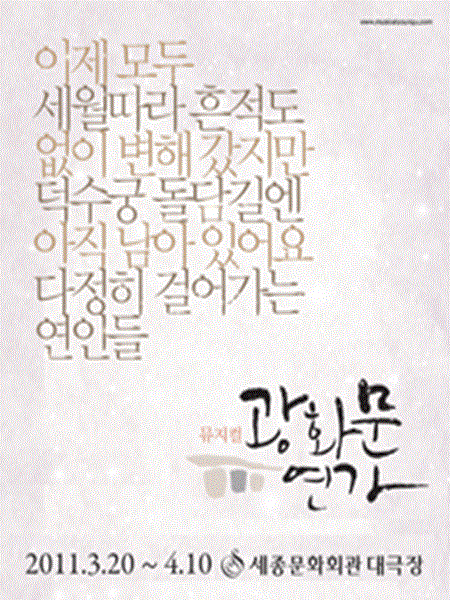
Representative Korean Production Poster
Posters included in this archive are embedded solely for documentary and educational purposes.
🔗 All images are linked to their original sources or articles. No copyright ownership is claimed.
Gwanghwamun Love Song
광화문 연가
Literal Translation

SOURCE
jukebox
SETTING
Korea
BOOK
original
The songs of composer Lee Young-hoon
Korean Premiere
Year:
2011
Theatre:
Sejong Center, Seoul
References


Summary
A Korean jukebox musical built around the songs of composer Lee Young-hoon, first staged in 2011 and revived in 2012.
Origin & Development
Premiered in March 2011 at the Sejong Center for the Performing Arts, produced by Seensee Company, directed by Lee Gina (이지나), with arrangements by Lee Kyung-seob (이경섭) and music direction by Kim Moon-jung (김문정). The musical was conceived as a tribute to the late composer Lee Young-hoon, using his hit songs (〈광화문 연가〉, 〈사랑이 지나가면〉, 〈옛사랑〉 등) to frame a three-person love story set against 1980s Seoul. ⚠ Title clarification: This 2011 version is not the same work as the 2017 CJ ENM musical of the same title. The two productions share the song catalog but have completely different books, plots, and production teams.
A separate follow-up concert version, 광화문 연가2 (2013), also exists and was later licensed to China — but it is considered a different work from the 2011 musical. The 2011 production was revived in 2012 and later exported to Japan in 2013, where it was staged in Korean with Japanese surtitles at the Meijiza Theatre. 2011 – Premiere (Sejong Center Grand Theater, Seoul)Large-scale original production with Yoon Do-hyun, Song Chang-ui, Kim Moo-yeol, and Lisa leading the cast. 2012 – Revival (LG Arts Center, Seoul)Re-staged with revised ensemble structure and continued box-office success, leading directly to overseas interest.
Full Synopsis
Sang-hoon, now an established composer, is pulled back into the memories of his youth when a familiar melody reminds him of a long-buried past. The story shifts to 1980s Seoul, where the young Sang-hoon, his protégé Hyun-woo, and a singer named Yeo-ju meet inside the live café “Blue Azit,” bound first by music and then by growing affection. Both men fall for Yeo-ju, but their musical ideals collide with the reality of student protests, censorship, and the commercial pressures of the era. A song completed with Sang-hoon’s guidance spreads through the protest movement, turning Hyun-woo into an unintended symbol of resistance — and eventually leading to his arrest. While Hyun-woo disappears from sight, Sang-hoon and Yeo-ju slowly grow closer, only for Hyun-woo to return years later and reopen wounds neither of them has fully faced. Blending romance, memory, and the longing of songs that outlive their singers, the musical paints a portrait of love and artistic youth forever tied to the streets of Gwanghwamun.

光化門恋歌
2013
2013-01-01
to
2013-01-26
Country:
Japan
Production Type:
Licensed
City:
Tokyo

Language:
Korean
Venue:
Meijiza
Marketed as the musical's first overseas presentation, it was performed by a full Korean cast including U-Know Yunho (TVXQ), Sungjae (Supernova), and Choi Min-hwan (FTISLAND). The production kept the original Seoul staging with Japanese surtitles.

Production Type Key — Letters grow with the scale of the production, from workshop to licensed production.

English Title Verification
English Title Translated Literally (Unofficial Third Party Usage Confirmed)
Gwanghwamun Love Song | Accessed: 2026-10-17
Official English titles in this database are extracted only from primary sources. These include:
-
materials released by the production company, credited creative team, or venue, including their official pages on social media, YouTube, and similar platforms;
-
official English listings on ticketing sites;
-
official industry events such as the K-Musical Market;
-
interviews in which a creative team member clearly gives the English title.
English titles that appear only in translations by others, such as news articles, reviews, or fan materials, are not included as official titles. When no primary-source English title exists, the title is recorded as a literal translation and labeled on the left as either “Unofficial Third Party Usage Confirmed” or “No English Title Found,” depending on whether an English title has appeared in the media or elsewhere.
“Captured” is the date the screenshot was taken. “Accessed” is the date the search for an English title was last carried out. English titles may change when a production revises them for a later staging. Entries are updated to the most recent official title where possible, though updates may lag behind such changes.
Some source pages have been observed to change or disappear over time, so screenshots are kept here at a reduced but legible resolution. They serve only to document the title as it appeared on the date shown. Clicking an image opens its original source page. All rights to the captured material remain with their respective owners. Inclusion does not imply affiliation with or endorsement by any rights holder.