
Fan Letter
팬레터

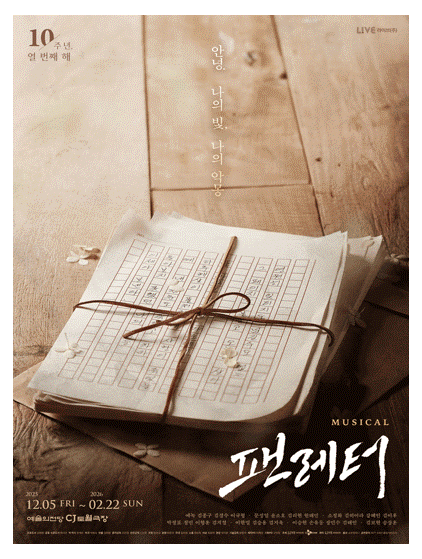
Set in 1930s colonial Seoul, Fan Letter follows Sehoon, an aspiring writer who writes letters under the name Hikaru to the novelist Haejin. The correspondence fuels Haejin’s work but turns into deception, splitting Sehoon’s inner self. Through a fiction believed to be real, their writing ultimately becomes a shared novel.
Musical Reviews › Korean Original › 2025
Seoul Arts Center CJ Towol Theater
Venue:
2025
Attended:
Premiere:
2016
Related Pages
K-Musicals in Non-English-Language Markets:
Posters included in this archive are embedded solely for documentary and educational purposes.
🔗 All images are linked to their original sources or articles. No copyright ownership is claimed.
CLICK for
KOREAN Show
Review

SYNOPSIS & REVIEW
Synopsis
Set in 1930s Seoul—then known as Gyeongseong—under Japanese colonial rule, the story opens with Sehoon traveling to Japan to visit Lee Yoon, an imprisoned novelist and a close associate of the late writer Haejin. Sehoon has learned that a novel attributed to Hikaru, believed to be a deceased female writer and Haejin’s lover, is about to be published, raising the possibility that the author’s true identity may be exposed. He begs Lee Yoon to stop the publication. Lee responds mockingly, claiming that he possesses the final letter Haejin wrote to Hikaru, and demands that Sehoon explain why he is so desperate to see it.
The stage rewinds to the past.
After a conflict with his father, Sehoon runs away from home and finds refuge with a group of young writers known as the League of Seven, a literary circle that has never actually reached seven members. Frustrated by the lack of recognition for serious literature under colonial rule, they plan to publish a Korean-language literary magazine. They decide to recruit Haejin, a rising writer suffering from tuberculosis, invite him to join the group, and he agrees. Sehoon becomes their errand boy, having nowhere else to go and needing a place to stay, while assisting the writers he admires.
Haejin confesses that his motivation to write comes from letters sent by a woman named Hikaru, who encourages him through correspondence. In truth, Hikaru does not exist. The letters are written by Sehoon himself, using the pen name Hikaru. Initially uncertain, Sehoon continues the correspondence, believing that the letters sustain Haejin’s will to write. As he writes, Hikaru emerges as a distinct presence within Sehoon’s mind, expressing confidence and language that Sehoon himself would not dare to use.
Sehoon’s inner conflict intensifies as Hikaru urges him to push Haejin to write despite his worsening health, arguing that literary achievement matters more than survival. Meanwhile, an anonymous report alerts the authorities that the League of Seven is producing Korean-language writings deemed dangerous. Fearing arrest, the members burn some potentially harmful manuscripts and disband. Lee Yoon grows suspicious of Hikaru’s identity and questions Sehoon about how the letters were sent, but the remaining members interrupt the confrontation, fearing arrest, and leave the office amid the turmoil.
Haejin later receives a letter from Hikaru inviting him to meet her. At the meeting place, he encounters Sehoon, who claims that he too received a letter from Hikaru. Encouraged by a recent manuscript sent under Hikaru’s name, Haejin resumes writing, but his health rapidly deteriorates. Unable to maintain the deception, Sehoon confesses that he himself is Hikaru and urges Haejin to take his medicine. Haejin responds that Sehoon should not have revealed the truth, suggesting that he may already have known it. With the confession, Hikaru disappears from Sehoon’s inner world, and Haejin leaves. As Haejin dies, he writes a letter to Sehoon that his letters gave him the various shades of love and the sensitive and pure words gave him reason to live, and would expect a reply as he always did.
The story returns to the prison visiting room. Lee Yoon reveals that the final letter was a fabrication intended to draw out Sehoon’s confession. He tells Sehoon that he is a genuine writer and should continue writing. Lee Yoon dies of tuberculosis shortly thereafter.
In the former office of the League of Seven, the members announce the publication of Haejin’s novel, completed with Sehoon’s final revisions. Now formally recognized as a member of the group, Sehoon delivers a eulogy for Haejin. As he speaks, Haejin appears alongside Hikaru onstage. Haejin gently urges Hikaru forward, and Sehoon embraces her. Haejin and Lee Yoon join them, completing the League of Seven at last.
Review
Haejin and Lee Yoon are characters inspired by real Korean writers Gim Yujeong (김유정) and Yi Sang (이상), both associated with the literary circle known as the League of Nine (구인회), active between 1933 and 1937. Other historical figures from that group—such as Yi Tae-jun (이태윤), Kim Ki-rim (김기림), and Kim Hwan-tae (김환태)—also appear in the musical, under either their original names or modified ones, as members of the fictional League of Seven. While the characters are rooted in historical context, the narrative itself is a work of fiction.
The story begins with a seemingly familiar premise. Sehoon, an aspiring writer from a wealthy family, begins writing letters under the pen name Hikaru to the author Haejin, whom he deeply admires, while studying in Japan, in growing resistance to his father’s way of life. As the conflict deepens, he eventually leaves home. What begins as admiration gradually escalates. Haejin develops a fantasy around Hikaru, investing the correspondence with emotional intensity and eventually regarding her as the center of his life and his motivation for writing. Sehoon, realizing the effect of the letters, chooses to sustain the illusion. He continues writing, inventing circumstances—including Hikaru’s supposed tuberculosis—to explain delayed replies and the impossibility of meeting.
As the deception deepens, Sehoon’s inner world begins to split. One side of him remains concerned with Haejin’s health and wishes to protect him, even longing to stay close. When suspicions about Hikaru’s identity grow within the League of Seven, Sehoon anonymously reports the group’s activities, contributing to its disbandment and leaving Haejin isolated. Even then, Sehoon’s attachment is rooted less in possession than in concern for Haejin’s survival and recovery.
Hikaru, however, represents a different drive. She urges Haejin to write relentlessly, arguing that as a terminally ill man, it is meaningless for him to die without leaving behind a significant body of work. She confronts Sehoon repeatedly, forceful and uncompromising, and gradually comes to dominate his actions.
In the end, Sehoon confesses that he wrote all the letters attributed to Hikaru, as well as the manuscript sent to Haejin. Hikaru vanishes, revealed as a projection of Sehoon’s inner self. What emerges is not a story about romantic fixation or simple admiration, but about authorship and compulsion. Sehoon’s deepest desire is not to possess Haejin, nor to be loved by him, but to see him write a masterpiece at any cost. Hikaru’s strength comes from that desire—not from romance, sexual longing, or fandom, but from an uncompromising belief in the primacy of the work itself.
The musical’s structure, built around letters and delayed revelations, depends heavily on language. This made the opening number, centered on posthumous works, an uneasy entry point. The vocal harmonies did not always lock cleanly, but more disorienting was the difficulty of following the lyrics at all. The sound leaned heavily into resonance, and a combination of hall acoustics and sound design blurred consonants, softening textual clarity at the very moment when orientation mattered most. With the band’s texture largely centered around the piano, the harmonic space felt compressed, limiting both clarity and contrast. In a piece where words are the engine of action, this initial opacity created distance. There were two monitors on the side walls displaying Japanese subtitles. I looked at them for clues to the lyrics but could not follow them, not knowing Japanese.
As the story settled, however, the performances themselves began to draw focus. Hikaru was sung by a performer with clear technical command; the voice carried easily and with confidence, though sustained phrase endings often opened into a wider vibrato, particularly on longer held notes. Sehoon, by contrast, felt grounded both vocally and dramatically. His singing was stable, his acting attentive, allowing the character’s uncertainty to register without excess. Haejin’s music often inhabits a soft upper range, and there were moments when those phrases felt exposed, but when the line descended, his voice thickened noticeably—pitch settling, resonance deepening, the sound acquiring a centered, convincing vibration.
What matters most in Fan Letter is not classification but accumulation. Sehoon’s admiration for Haejin begins as something boyish and sincere, then gradually entangles itself with invention. Through Hikaru—his pen name, his imagined equal, his emotional extension—Sehoon creates not only encouragement but material: letters, language, and ultimately a substantial manuscript. Haejin responds not as a man indulging a fantasy, but as a writer recognizing another writer. He works on Hikaru’s manuscript, regarding her as a genuine collaborator, and the novel that survives him emerges from that shared process, later edited by Sehoon after Haejin’s death.
The stage functioned primarily as the space of the League of Seven, while locations such as the prison visiting room or Sehoon’s living quarters were staged at the corners and concealed after each scene. Backlit lattice window panes served as surfaces for shadow acting, which were used frequently and effectively. One of the most striking staging choices was the use of loose manuscripts scattered across the floor in the latter half of the second act. During moments of conflict, manuscripts were repeatedly thrown down—some retrieved by Haejin, but many left scattered, visually accumulating Sehoon’s desperation. This proved more effective than elaborate props, and the falling pages during Haejin’s final numbers intensified the effect further.
The band included violin, cello, and other instruments, but the overall balance was weighted heavily toward the piano, leaving the remaining instrumental lines comparatively subdued. More noticeably, the actors’ voices carried with a slightly prolonged resonance, which blurred consonants and intensified vibrato. Sitting in the second-floor balcony, first row, center—a position that would normally provide clear, well-focused sound—I found myself momentarily checking my ears, as the audio felt unusually diffuse. During intermission, I overheard a comment that Korean surtitles might have helped, echoing the same difficulty in following the text. The issue was not overwhelming, but it became more apparent in lower-register passages, where clarity softened further, and in highly resonant upper phrases, where vibrato felt less stable.
By the final moments, when the dead return to the stage and the League of Seven is at last made whole, the resolution feels less like closure than acknowledgment. What remains is not a verdict but a record: of writing done under constraint, of words exchanged in faith, and of a collaboration that was real precisely because it was believed to be so.
I can see why this show has been loved both overseas and in Korea for over a decade. The songs are strong, and I particularly enjoyed the duets between Sehoon and Hikaru, with their playful rhythms. The characters are well balanced: the League of Seven writers, the slightly dreamy Haejin, and the sharp-tongued Lee Yoon. I also appreciated the voice of Yi Tae-jun, especially his baritone range. Hikaru carries much of the show through intense musical numbers and shadow-like interactions with Haejin. Sehoon, too, is an attractive role that many actors would want to play, demanding a wide emotional range, strong musical numbers, and moments of dance.
While dealing with near-modern Korean history, the show approaches its subject with restraint and nuance. Rather than being overshadowed by historical figures, it draws on an episode associated with Gim Yujeong’s infatuation with a woman he never met, reshaping it into a plausible narrative through Sehoon’s split self—a manifestation of a deep, dark desire that is neither love nor lust, but the urge to see a life’s work completed in the form of a novel. The musical approaches, but never crosses, boundaries related to political or gender issues. I would gladly return to see it again, ideally in a space with a more balanced sound system.
All photos in this gallery were taken personally when photography was allowed, or are of programs, tickets, and souvenirs in my collection.


