top of page


광화문 연가(CJ ENM 뮤지컬)
Gwanghwamun Love Song (광화문 연가) is a Korean jukebox musical built from the songs of composer Lee Young-hoon, following a man’s final memory journey through love, regret, and time in modern Korean history.
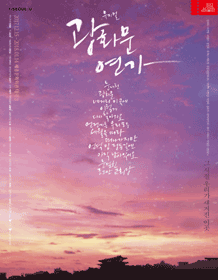
Posters included in this archive are embedded solely for documentary and educational purposes.
🔗 All images are linked to their original sources or articles. No copyright ownership is claimed.
SOURCE
jukebox
SETTING
Korea
BOOK
original
Productions in Korea (🔴 = Seoul Large Theatre Production)
2017.12 🔴 Sejong Center for the Performing Arts (Seoul)
2018.11 🔴 D-Cube Arts Center (Seoul)
2021.07 🔴 Seoul Arts Center Opera House (Seoul)
2024.10 🔴 D-Cube Link Arts Center (Seoul)
2026.08 🔴 D-Cube Link Arts Center (Seoul)
SYNOPSIS
(Full Synopsis)
Set between the 1980s and the present, the musical unfolds across memory and reality, where a dying man revisits his life to rediscover the meaning of love.
Myung-woo, a composer in his fifties, lies at the edge of death. In the final moments of his life, he enters a liminal space known as the “house of memory,” where he meets Wolha, a mysterious guide who governs fate and relationships.
Under Wolha’s guidance, Myung-woo travels back to his youth, beginning in 1984 at Gwanghwamun, where he first encounters his first love, Soo-ah. Their relationship blossoms amid the backdrop of a turbulent era marked by political unrest and student movements. However, their differing responses to the times—Soo-ah’s active participation in protests and Myung-woo’s hesitation—gradually drive them apart.
As time passes, Myung-woo continues his life, eventually becoming a composer and marrying another woman, Si-young. Despite building a life together, his memories and music remain haunted by Soo-ah, who becomes an idealized figure within his inner world.
During his journey through fragmented memories, Myung-woo begins to realize that many of his recollections have been distorted or reshaped by longing and imagination. The version of Soo-ah he remembers is not entirely real, but a reconstruction shaped by regret.
In the final stage of his journey, Myung-woo arrives at a quiet riverside where he confronts Si-young, the person who stood by him throughout his life. He comes to understand that while his first love defined his youth, it was Si-young who shared his life until the very end.
Accepting this truth, Myung-woo completes his final memory and prepares to depart. The musical concludes as he embraces his life with clarity, guided onward by Wolha, leaving behind a reflection on love, memory, and time.
PRODUCTION NOTE
This version of Gwanghwamun Love Song was produced by CJ ENM in collaboration with the Seoul Metropolitan Musical Theatre Company and premiered in 2017. While it shares its title and source composer (Lee Young-hoon) with earlier works, it is structurally and dramaturgically a distinct production.
The original 2011 version of Gwanghwamun Love Song was a different narrative centered on a composer’s past relationships and creative identity, using a separate storyline and character framework. In 2013, Gwanghwamun Love Song 2 was developed as a concert-style jukebox musical featuring idol characters and live performance structure, diverging further from the narrative-driven format.
The 2017 CJ ENM production represents a comprehensive re-creation rather than a revival. It introduces a new narrative built around memory travel, adds the character of Wolha as a metaphysical guide, and incorporates literary elements such as the framing concept inspired by poetry. The structure, characters, and dramatic arc were extensively reworked, effectively establishing it as a new work sharing only the musical source material with its predecessors.


REFERENCES
Synopsis Sources
NamuWiki – CJ ENM Version Synopsis
Wikipedia – Musical Overview
Articles & Reviews
Yonhap Review – Memory & Narrative
https://www.yna.co.kr/view/AKR20181228156500508
Chosun Review – Structural Changes
https://art.chosun.com/site/data/html_dir/2017/12/21/2017122102489.html
bottom of page