
Arang
몽유도원

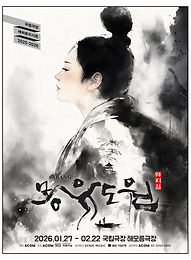
Arang reimagines a Korean folktale set in ancient Baekje, where a king’s obsession with a dream woman clashes with her bond to her husband. Through sacrifice, Arang and Domi’s love endures—while Yeogyeong falls as his illusion shatters.
Musical Reviews › Korean Original › 2026
Haeoreum Grand Theater
Venue:
2026
Attended:
Premiere:
2002
Posters included in this archive are embedded solely for documentary and educational purposes.
🔗 All images are linked to their original sources or articles. No copyright ownership is claimed.
CLICK for
KOREAN Show
Review

SYNOPSIS & REVIEW
SYNOPSIS
Act I
Yeogyeong, King of Baekje (c. 5th century), suffers from chronic insomnia. While drifting into uneasy sleep upon his throne, he dreams of a mysterious woman. Despite pressure from his ministers to choose a Queen in order to strengthen royal authority, Yeogyeong insists that his heart is already claimed and orders his trusted general, Hyang-sil, to find the woman from his dream.
In the secluded land of Dowon, the Mokji Tribe lives in quiet isolation. The tribe celebrates the wedding of their Tribal Leader, Domi, and Arang, with the ceremony presided over by Bia, the Priestess, as they pray to the Moon for protection. While hunting to defend their crops from wild animals, Domi accidentally wounds Yeogyeong with an arrow. Recognizing Arang as the woman from his dream, Yeogyeong uses his injury as a pretext to remain in the village with Hyang-sil.
During a game of Baduk (Go), Hyang-sil reveals that he knows the tribe are the Mokji people, who were once enslaved after being accused of treason, and warns that Domi has injured the Great King of Baekje. To protect his people, Domi agrees to accompany the King to the capital under the guise of securing the tribe’s safety, leaving Arang behind in fear.
At the capital, Hyang-sil proposes a Baduk match between Yeogyeong and Domi to force Domi’s submission. Domi wagers the autonomy of the Mokji Tribe, while Yeogyeong stakes a personal wish. Yeogyeong wins. Domi is imprisoned, and Arang is brought to the palace. Yeogyeong declares his intention to make her Queen. Domi offers his life in exchange for the tribe’s survival, while Arang denies her bond with him and pleads for his release. Yeogyeong agrees to spare Domi but orders him exiled. Refusing to live without Arang, Domi asks for death instead. Enraged, Yeogyeong blinds him, declaring that he has no right to behold such beauty as Arang.
Domi is placed on a small boat and set adrift by Hyang-sil, lamenting his fate and praying for Arang’s safety.
Act II
The wedding of Yeogyeong and Arang begins, but a solar eclipse throws the ceremony into chaos. Amid the confusion, Arang disappears. Driven by obsession, Yeogyeong orders an all-out search.
Arang returns to Dowon in rags and urges Bia to flee with the Mokji people before the King’s forces arrive. Believing Domi to be dead, she sends a straw effigy of him down the river to mourn his death and tells Bia that she will search for his body to bury him properly. When Hyang-sil’s forces arrive, he sees Arang and attempts to take her back to the palace, but is halted when he sees the same boat that carried Domi drifting back upstream. Interpreting this as an omen, Hyang-sil allows Arang to escape by boat.
As the Goguryeo army attacks the palace, Yeogyeong refuses to flee or fight, choosing instead to go in search of Arang. When he finally finds Arang and the blinded Domi together, Arang unmasks and reveals her scarred face to Yeogyeong, causing him to awaken from his illusion and collapse. Seeing the King fall, Arang calmly asks Domi where they should go. He replies that as long as they are together, anywhere is Dowon—the Peach Blossom Land.
Returning to his collapsing throne, Yeogyeong mourns his shattered dream and is struck by an arrow as the palace falls. Arang and Domi drift away together on a boat, while the people of Dowon sing of hope for a new paradise.
Arang (몽유도원, Mongyudowon): A Critical Review
1. Overview and Production Background
Arang is a musical produced by ACOM. While it retains the core narrative framework of Mongyudowondo, which premiered in 2002, nearly all other elements have been newly rewritten, making it reasonable to regard this work as an entirely new original creation. The story is loosely based on The Tale of Mrs. Domi, an old Korean folktale. Directed by Yun Ho-jin and produced by Yun Hong-sun, the musical is built on a book by Ahn Jae-seung, with an entirely new score composed by Oh Sang-jun and lyrics by Yang Jae-seon. The orchestration and arrangements, combining traditional Korean instruments, strings, and band elements, were created by Jin-Hwan Kim.
The orchestra consists of fifteen players, including a five-member traditional Korean ensemble featuring daegeum, haegeum, taepyeongso, gayageum, and traditional percussion. The music director Moonjeong Kim conducted the orchestra. Stage design was created by Pilyoung Oh through Emotional Theatre.
This production marks a new artistic turn for ACOM and director Yun Ho-jin, who previously established the foundations of large-scale Korean historical musicals such as The Last Empress and Hero. Departing from grand, realistic stage conventions, Arang adopts an austere minimalist aesthetic rooted in symbolism, signaling a clear artistic shift for its creators.
2. Narrative Structure and Dramatic Setting
The story unfolds as follows.
King Gaero of Baekje, Yeogyeong, suffers from chronic insomnia and is plagued by recurring nightmares in which he is chased through a barren wasteland. In his dreams, a mysterious woman appears, transforming the barren landscape into a paradise-like realm, and he dreams that she saves him.
In the musical, Yeogyeong is portrayed as a king who ascended the throne twenty years earlier after the assassination of his father, King Biyu, and is characterized as having no interest in women. Powerful aristocratic clans, the Hae and Jin families, continually pressure and threaten the king, each seeking to strengthen their influence by placing a woman from their lineage on the throne as queen. To the north, Goguryeo grows in power and threatens Baekje, while Baekje responds through an alliance with Silla to the east.
Although the Hae and Jin noble families press Yeogyeong to choose a queen from one of their houses, the king insists that his heart already belongs to another woman and orders his general Hyang-sil to find the woman from his dreams. Convinced that his salvation in the waking world can be achieved only through this dream figure, Yeogyeong launches a search across the kingdom.
3. The Concept of Dowon and the Mokji People
Domi is the leader, or eupcha, of the Mokji people. In the musical, eupcha refers to the head of the smallest tribal unit within Baekje’s political structure. The Mokji are framed as descendants of Mokji-guk, a former Mahan polity whose people were enslaved after what is described as a rebellion and subsequently reduced to a servile status. The nature of this “rebellion” is left deliberately ambiguous, implying resistance during Baekje’s process of consolidation rather than a clear-cut act of treason.
Though later emancipated by King Biyu, the Mokji are portrayed as having been pardoned rather than fully rehabilitated, leaving their lineage socially stigmatized. Drawing on the historical memory of Mokji-guk as a once-dominant state within the Mahan confederacy that was eventually absorbed into Baekje, the musical presents Domi as the descendant of a marginalized, pardoned lineage, leading a small community that survives in seclusion, apart from the political center.
Dowon, literally the Peach Blossom Paradise, is a utopian space derived from the East Asian legend of the Peach Blossom Paradise. For King Yeogyeong, it represents the only illusion capable of curing his insomnia; for Domi and Arang, it is the hard-won land they have cultivated through their own labor. The same space thus carries opposing meanings: the desire of a ruler versus the refuge of common people, creating a central tension within the drama.
The people of Mokji are depicted as followers of an ancient shamanistic belief system centered on the moon. Bia serves as both priestess and shaman and is referred to as the Cheongwan. Arang, a beautiful woman of Mokji, is Domi’s beloved. Under the guidance of Cheongwan Bia, Domi and Arang’s wedding ceremony is performed as a ritual prayer to the moon, simultaneously serving as a rite to bless the harvest of the harsh yet beautiful land they have cultivated together.
4. Plot and Character Relationships
The drama centers on three figures: King Gaero of Baekje (Yeogyeong), Domi, and Domi’s wife Arang. The plot itself is relatively straightforward. The historical pressures faced by King Gaero—including aristocratic opposition and invasions from Goguryeo—are deliberately treated briefly, functioning primarily as devices to heighten dramatic tension rather than as fully developed historical subplots. This restraint appears intentional, streamlining a fifth-century Korean narrative for international audiences by prioritizing clarity and accessibility over historical exposition.
Yeogyeong, wielding absolute power, pursues the woman from his dreams, convinced that she alone can save him from his nightmarish reality. At first, he seeks to legitimize his claim by proposing a game of baduk (Go) to Domi, using the wager as a calculated pretext to seize Arang, who is already married. Gradually consumed by madness, he loses his reason and seeks to destroy Domi. In his relentless pursuit of the fleeing Arang, Yeogyeong awakens from his illusion only when confronted with her after she has lost her beauty, ultimately bringing about his own downfall.
Domi and Arang’s love is tested by adversity, yet they do not surrender. They rise again to confront their fate, and by the final scenes, they are presented as having attained a state of quiet, hard-won peace.
5. Musical Numbers and Their Dramatic Function
Yeogyeong’s musical numbers chart his psychological descent: songs yearning for the woman of his dreams; jealousy upon seeing her married to Domi; a declaration of ownership after killing his loyal general Hyang-sil; and finally, songs marked by emptiness and total collapse after all is lost.
As lovers, Domi and Arang share numerous duets and ensemble numbers. These include their wedding ceremony, songs of longing while separated, whispered pleas before the king for each other’s survival, a deeply emotional reunion number, songs expressing contentment in a life of begging and poverty, and finally, a song sung as they journey toward Dowon.
Domi’s solo highlight occurs at the end of Act I, when he sings while blinded and set adrift on a river, the number distinguished by its strong traditional Korean instrumentation. This moment stands as one of the musical’s finest. Arang’s major solo is a powerful belting number in which she realizes that her beauty has brought suffering and resolves to act upon that realization.
6. Orchestration and Musical Language
The orchestration encompasses traditional Korean music, strings, percussion, and band elements, at times resembling traditional vocal forms, at others employing conventional musical theatre language, and occasionally extending into electronic soundscapes. While it is possible to classify numbers by dominant genre, in practice the color of each piece shifts significantly depending on the performer’s background.
Bia’s numbers and spoken lines offer a representative example. The role of Bia is double-cast between Hong Ryoon-hee, a classically trained musical theatre performer, and Jung Eunhye, a pansori singer. Bia’s music includes spoken passages during the wedding ceremony, ensemble numbers, a duet expressing concern for Domi alongside Arang, and songs about seeking a new Dowon.
Hong Ryoon-hee delivers both songs and dialogue through musical theatre vocal techniques, including ritual incantations shaped by musical theatre conventions. Jung Eunhye sings in a pansori style and delivers dialogue in aniri, spoken-word narration in Korean pansori, while maintaining clear pitch structures. A comparison of their interpretations alone reveals the work’s remarkable flexibility: it can lean toward changgeuk or toward conventional musical theatre, depending on the performer. The melodies themselves are grounded in traditional Korean scales, allowing a Korean musical sensibility to emerge regardless of vocal approach, further reinforced by the traditional instruments that support and connect the vocal lines.
7. Rhythm and Scene Transitions
Early in Act II, a wordless scene featuring large drums positioned on both sides of the stage proves highly effective. Adorned with the three-legged crow motif—a mythical bird revered as a sacred and royal symbol—the drums evoke fifth-century Baekje iconography, sharply contrasting with the ordinary crow invoked pejoratively in the dialogue.
8. Popular Narrative and Cultural Translation
The song sung by the residents of Dowon, followed by Arirang, integrates national identity through music. Though closely associated with the familiar folk song, it is sung with a slightly different pronunciation from the well-known Arirang, i.e., 아르랑 in Korean and presented as an original composition.
One of Arang’s greatest strengths lies in its refusal to foreground nationalism or to frame its narrative around conflicts with foreign countries. While nationalism may sell domestically, it often complicates cultural translation when a production travels abroad. Although the story is rooted in Baekje history and folklore, its dramatic tensions are confined to internal dynamics within an early Korean court society—ambition, desire, moral compromise, and the exercise of power—rather than to culturally specific conflicts that demand extensive cultural context. The narrative ultimately centers universal themes such as love and jealousy, the greed of those in power, and the quiet resilience of ordinary people. As a result, the work poses little challenge in terms of cultural translation; what remains is largely an aesthetic decision about how much of Baekje’s historical color and atmosphere to retain.
9. Historical Aesthetic and Stage Design
Unlike many Korean historical musicals that focus on the Joseon dynasty or the Japanese colonial period, this work is set in fifth-century Baekje, corresponding to the Samhan era. The Baekje aesthetic described in the Samguk Sagi—characterized by restraint without plainness and splendor without excess—is effectively realized in the costumes. Reflecting Baekje’s advanced weaving and dyeing techniques, the production employs rich colors and draped silhouettes.
Although the stage embraces minimalism, it is in constant transformation. The throne and the Dowon altar shift laterally, boats glide across the floor, tracing fluid, shifting paths, and four layered columns move continuously to divide and reconfigure the space. Rear LED imagery reflects off the floor, blurring the boundary between physical reality and projected image. Rather than simplifying space, the design presents a world in continual creation and dissolution, visually expressing the instability of the characters’ world.
10. Performers and Vocal Interpretation
Min Woo-hyuk and Julian Jootaek Kim, who share the role of Yeogyeong, are well suited to portraying both royal authority and pathological obsession. Min gradually embodies Yeogyeong’s descent into madness through vocal delivery and fluid physical movement. Kim deliberately restrains operatic technique, instead using breath control and fragmented phrasing to convey psychology, while employing his characteristically dark, weighty lower register to powerful effect in moments of madness. His spoken dialogue also effectively conveys the king’s hierarchical authority and fixation.
Arang is portrayed by jeongga singer Ha Yun-ju and musical theatre actress Yuria. Ha alternates between traditional jeongga technique for Korean melodic passages and musical theatre technique in moments approaching a scream, occasionally producing compressed, tearing sounds reminiscent of pansori in expressions of grief. Yuria demonstrates a wide vocal spectrum, moving fluidly from delicate low tones to full belting with dramatic clarity.
The role of Domi is shared by Lee Choong-joo and Kim Sung-sik. Lee reveals a new dimension of his artistry through Korean melodic phrasing rarely seen in his modern roles, particularly in the Act I finale. Kim Sung-sik conveys both Domi’s clarity and anxiety through a sensitive blend of traditional and musical theatre vocal styles. Alternate cast member Yoon Je Won adds a distinctly pansori-inflected texture to the role.
Although Hyang-sil primarily appears in duets and ensemble numbers, his solo admonishing the king evokes the loyalty of Rodrigo in Don Carlo. Seo Young-joo and Jeon Jae-hong respectively portray Hyang-sil as loyal to the king as an individual and to royal authority itself, each delivering the role’s dramatic material effectively.
11. Ensemble and Choreography
The ensemble forms the core of this production. Dance vocabulary infused with traditional Korean movement, expansive musical numbers, and above all, rich harmonies leave a lasting impression. While the harmonic writing itself is solid, the resonant sound filling the theatre would not be possible without the performers’ exceptional execution.
The male quintet and sextet numbers depicting the rivalry between the Hae and Jin clans are cleanly performed, with striking harmonic construction. The female ensemble smoothly navigates an avant-garde, string- and keyboard-driven number during the wedding scene of Yeogyeong and Arang, while mixed-gender ensembles balance wide vocal ranges with firm low registers and gentle upper lines.
Choreography centers on Korean movement while incorporating elements of contemporary dance and street styles to modernize traditional forms. Most striking is the scene depicting the baduk match between Yeogyeong and Domi as a dance confrontation between black and white stones. Baduk, known internationally as the game of Go—the same “go” referenced in AlphaGo—is similar to chess but more complex, using flat, round black and white stones to expand territory across the board. Encirclement, escape, and the flow of the game are rendered through movement, culminating visually in Yeogyeong’s victory with the final stone.
All photos in this gallery were taken personally when photography was allowed, or are of programs, tickets, and souvenirs in my collection.


