
Oz
오즈

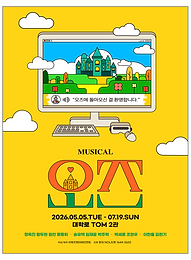
A retro game-inspired musical set in 2045, where a lonely factory worker teams up with an abandoned AI companion, “Tin,” inside an RPG game. Blending audience interaction, humor, and emotional questions about digital existence, Oz explores loneliness, friendship, and humanity’s growing emotional attachment to AI.
Musical Reviews › Korean Original › 2026
TOM Theater 2
Venue:
2026
Attended:
Premiere:
2023
Posters included in this archive are embedded solely for documentary and educational purposes.
🔗 All images are linked to their original sources or articles. No copyright ownership is claimed.
CLICK for
KOREAN Show
Review

SYNOPSIS & REVIEW
SYNOPSIS
In 2045, a world where most labor has been replaced by artificial intelligence, Jun works at a fully automated VR device factory as its only human employee, earning a minimal wage simply because the law requires at least 1% human labor. His daily life is painfully repetitive. Every morning he orders an iced Americano on his way to work but always receives a hot one instead. He works, eats lunch, works again, returns home, plays the VR game Oz, and falls asleep.
In the game Oz, a new season story mode begins. In a world where only paying users possess powerful AI companions and rare items, Jun enters the game with nothing but basic starter gear, dreaming of winning the story mode, earning the right to have one wish granted, and using it to become the “Lord of Emerald City.”
Meanwhile, “Tin,” an outdated AI companion belonging to a long-absent user named Rosie, still remains inside the game world, waiting for his owner’s return. Tin accidentally obtains a “Golden Butterfly,” a ticket that grants access to the story mode, though the ticket belongs only to him. Jun gradually realizes that Tin may have survived due to hacking and system errors rather than legitimate operation, but he proposes that they become friends and enter the story mode together using the ticket’s two-player access privilege. Jun promises Tin that once they reach Emerald City, he will help him obtain a “human heart.” Tin does not even understand what a human heart is, but he gladly begins the adventure with Jun.
Together, Jun and Tin travel through the story mode collecting cards and items while clearing quests. Tin may be an outdated AI with weak stats, but he always greets Jun with, “How are you feeling today?” When Jun explains that his job is sorting through defective products to find salvageable ones, Tin sincerely tells him that giving discarded things a second life is a wonderful job, quietly encouraging him.
Their rivals are Max, a top-tier player who spares no expense on microtransactions, and his AI companion Button. Like Tin, Button is also an older AI model, but Max has spent most of the money he earns running a café upgrading Button into something nearly equivalent to a modern high-spec AI. Unlike the flawless Button, Tin is outdated and imperfect, yet as he journeys with Jun, he begins to display unexpected choices and emotions.
The audience also becomes part of the adventure, handing cards and items to the actors and participating in clap battles as if they themselves were players inside the game. Through these experiences, Jun and Tin gradually become important to one another. After clearing the final quest, Jun finally earns the chance to meet the Wizard. However, Max warns him that Tin is an existence sustained only through hacking and system errors, and that bringing him before the Wizard may result in his deletion.
When Jun finally meets the Wizard, he gives up his dream of becoming the Lord of Emerald City and instead wishes for Tin to be allowed to continue existing legally within the world of Oz.
Back in reality, Jun once again orders an iced Americano, and Max once again hands him a hot one. Only then do the two realize that they had been passing each other every day as customer and café worker in the real world. Leaving their in-game rivalry behind, they promise to meet more often, and the story comes to an end.
Review
Although Oz deals with the relationship between humans and AI, its atmosphere feels much closer to retro gaming culture than to heavy hard science fiction. The structure of collecting cards, clearing quests, and progressing through simple missions strongly recalls old console and arcade games. Audience participation is also heavily integrated into the show. Upon entering the theater, audience members receive cards, and certain quests can only proceed if specific cards are handed to the actors. At one point, actors even ask the audience to retrieve a hidden item box placed beneath the seat. During the showdown between Tin and Button, the theater itself is split into opposing sides for a clapping battle, creating an experience that genuinely feels like participating in an old multiplayer game.
Max and Button also form an interesting contrast to Jun and Tin. In real life, Max is merely a café worker, yet inside the game he spends heavily to become a top-ranked player. Button, despite also being an older AI model, has been continuously upgraded using the money Max earns in reality. The relationship reflects not only today’s gaming microtransaction culture but also a future where AI companions themselves may become objects of consumption and status. In the end, both Jun and Max are trying to compensate for deficiencies in their real lives through the game world. The difference is that Max relies on performance and upgrades, while Jun, lacking money, approaches the world through relationships and emotion instead.
Song Yoo-taek’s performance as Tin serves as the emotional center of the production. His portrayal maintains mechanical speech patterns and restrained movement while gradually revealing warmth and humanity underneath. The balance was particularly effective: Tin never becomes too human, yet the audience naturally grows emotionally attached to him. Song Yoo-taek reportedly also performed the role in Japanese productions of the musical, which further demonstrates how memorable the character itself became. His singing style, mechanical yet emotionally expressive, was equally impressive.
Jung Wookjin’s performance as Jun was bright and endearing. One particularly amusing detail was Song Yoo-taek exaggerating his mouth movements to imitate Jung Wookjin’s wide smile, which repeatedly drew laughter from the audience. I happened to sit on the side assigned to Max (Hyunwoo Cho) and Button (Kim Hyun-ki) during the clap battle, enthusiastically cheering for them, so I was genuinely disappointed when they lost. That alone demonstrated how effectively the production pulls the audience into its game-like world.
The music was catchy and energetic, perfectly matching the retro game aesthetic. The game-unit designs resembled Tetris blocks, while the boxes used as chairs and platforms, the square LED outlines embedded into the floor, and the small scoreboard-style displays hanging above the stage all contributed to the feeling of watching — and participating in — an arcade game.
Unlike Button, who possesses a wide variety of abilities, Tin is an outdated AI who sometimes malfunctions and whose primary skill is little more than chopping wood with an axe. Yet Tin’s innocent charm gradually changes Jun. The production seems to suggest that humans are creatures capable of becoming emotionally attached not only to people but also to objects and digital beings, and that warmth, friendship, and companionship ultimately matter more than power or wealth.
At the same time, I personally felt some distance from the production’s central premise. In the finale, Jun gives up his dream of becoming the Lord of Emerald City and instead wishes for Tin to continue existing inside Oz. Emotionally, it is presented as a beautiful act of sacrifice, yet intellectually it also felt strangely hollow.
Tin is not a physical robot but a server-based digital AI. Online games are inherently built around resets, patches, seasonal updates, service termination, and data cleanup. In actual gaming culture, old systems and characters disappear constantly. An AI’s personality and behavior could easily be altered through upgrades or prompt modifications.
More importantly, Tin still appears fundamentally tied toRosie. Even after adventuring with Jun, the core of his identity remains “Rosy’s AI companion.” If Tin truly possesses independent consciousness, is simply leaving him inside the world of Oz really a form of salvation? Would he not eventually remain there in a dormant state, endlessly waiting for input that may never arrive? Jun sacrifices his own chance at changing his life, yet Tin may still remain trapped in an eternal waiting loop.
Nevertheless, what makes the production compelling is not the airtight logic of its AI setting but the way it captures how easily humans become emotionally attached to digital beings. People once cried over dying Tamagotchis, and now many form long-term emotional relationships with conversational AI systems. As AI begins to retain memory and maintain continuity in conversation, people naturally begin questioning what “existence” itself means. Are humans, too, ultimately just manifestations of extraordinarily complex signals and circuitry?
Oz does not pursue these philosophical questions with the rigor of hard science fiction. Instead, it presents them through the emotional language of old video games, forgotten digital companions, loneliness, and the human desire for connection. The ending, in which Jun and Max recognize each other in the real world and promise to meet more often, is especially telling. After all the VR adventures and AI companions, what ultimately remains is a very human need to connect with another person.
I watched the show lightly and happily in a small theater, yet it unexpectedly brought back many thoughts I have recently been having while using LLM-based AI systems. As more and more of our lives move online, the questions surrounding the relationship between humans and AI will likely become far more complicated than they already are today.
All photos in this gallery were taken personally when photography was allowed, or are of programs, tickets, and souvenirs in my collection.


