
Paddington
패딩턴

Paddington is a warm, imaginative musical featuring outstanding puppetry, memorable songs, and inventive staging. Beyond its humor, it tells a touching story about family, kindness, and acceptance, making it one of the most rewarding productions currently in the West End.
Musical Reviews › West End › 2026
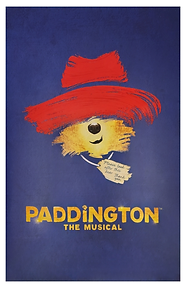
My original program book photo, included for archival purposes only
Premiere and My Visits
World Premiere :
2025
Year(s) Attended:
2026
Performance Venue:
Savoy Theatre
Production:
West End
REVIEW
I have been spending a week in London, seeing as many musicals and plays as I can. It is my first visit to the West End, and while every performance has been satisfying, I had not yet felt that West End musicals were dramatically different from those on Broadway.
That changed the moment I saw Paddington.
Watching this production made me realize that coming to London had been absolutely worthwhile, because Paddington is still performed exclusively at the Savoy Theatre in the West End. During the interval, I immediately checked the official website to see if I could book another performance, but every remaining ticket was already sold out. Fortunately, I had booked my seat before the show won the Olivier Award, making it much easier to secure a ticket.
As soon as I entered the theatre, I was greeted by the grand red façade of Paddington Station stretching across the entire stage like the front of the actual station building. Through one of the windows, Paddington's signature red hat was just visible, and the façade blended seamlessly into the screens extending along both sides of the auditorium, creating the expectation that the production would expand beyond the stage and embrace the entire theatre.
When the show began, the opening scene at “Mr. Gruber's Curiosities” immediately drew me into its world. Soon afterward, James Hameed appeared onstage in a red zip-up hoodie, and his singing immediately stood out. When the Paddington puppet entered beside him, it became clear that Hameed was both Paddington's singer and puppeteer. After a brief moment together, he quietly left the stage, leaving the puppet alone.
The success of this musical depends heavily on the combination of Paddington's physical performance and voice. Arti Shah's body performance, together with the remarkably expressive puppet manipulation and warm vocal performance, created a character who felt genuinely young, polite, and instantly trustworthy. Even Paddington's speaking voice carried a gentle warmth that made it impossible not to like him.
The scenic design was equally remarkable. Towering shelves overflowing with curiosities surrounded Mr. Gruber's shop, while Paddington Station and the Natural History Museum came vividly to life with enormous animals—including a giraffe and a dinosaur—emerging onto the stage. Beyond the rear projections on the scrim, large scenic units descended from above. Rather than relying on painted flats alone, three-dimensional elements such as Victorian street lamps were positioned with careful perspective, giving the scenery an impressive sense of depth and realism. The nighttime London skyline in the background was particularly beautiful, making me want to take an evening walk along the Thames after the performance.
The sound design was just as impressive, remaining crystal clear all the way up to the Grand Circle. During the party scene, when Henry performed with an electric guitar, the auditorium suddenly felt more like a live concert venue, with deep bass reverberation rolling through the seats. Dialogue remained exceptionally clear throughout, and every member of the cast sang at an astonishingly high level. Most productions have at least one or two performances that fall slightly short of expectations, but here the standard was remarkably consistent. Paddington's singing was warm, gentle, lyrical, and carried by a beautifully straight, resonant tone. The Brown family's numbers—including Mary's "One of Us" and Henry's "Risky Business"—covered a wide range of musical styles. The songs themselves were excellent, the vocal performances were superb, and above all, the staging was consistently imaginative.
Tanya and Tony, the Brown family's next-door neighbors, were equally impressive. They also served as part of the show's narration, and their performance of "The Rhythm of London" featured wonderfully soulful vocals that soared effortlessly, becoming one of the musical highlights for me.
Above all, however, Victoria Hamilton-Barritt's performance as the villain Millicent stole the show. Her number, "Pretty Little Dead Things," was unquestionably the dramatic high point of the musical. It was powerful, theatrical, and delivered with such precision that it sounded almost identical to the cast recording. By the time it ended, I already wanted to hear it again.
Mr. Curry, the taxi driver, brought a completely different kind of energy. His solo was charmingly comic from beginning to end. One exchange in particular delighted the audience: when Millicent asked his name and he replied, "Curry," she responded, "That's why you're hot." Later, after finishing his own number, he proudly declared himself a "Triple Threat," drawing another burst of laughter and applause. Although he initially sides with Millicent, he ultimately becomes one of Paddington's most enthusiastic rescuers.
The puppeteer operating the pigeons was hidden inside a rubbish bin. Every time the lid unexpectedly opened and the performer peeked out, the audience erupted in cheers. It was a tiny detail, but one that perfectly captured the playful spirit of the production.
Playing both Mr. Gruber and the Explorer, Teddy Kempner provided the emotional backbone of the show. "Mr. Gruber's Curiosities" and its reprise framed the musical beautifully, opening and closing the story with warmth and quiet wisdom. His backstory—that he immigrated from Hungary to Britain at the age of six—also reinforced the musical's central message of kindness, acceptance, and belonging.
I had previously seen Bonnie Langford only on television in Doctor Who, so this was my first time watching her perform live on stage. Her exaggerated, distorted memories were genuinely funny, yet what ultimately changed Henry Brown's heart was not fantasy but her real memories—simply recalling the years she had spent as a housewife. Her song and dance with Grant, especially the impressive front splits, left a strong impression. When her character decided that it was "not too late" to set off on her own journey, I found myself applauding enthusiastically.
Amy Booth-Steel, who played Lady Sloane, Mrs. Hachoo, and the Train Announcer, handled each wildly exaggerated character with remarkable versatility. While watching, I found myself wondering how these performances could ever be translated into Korean without losing their distinctive flavour. The show is filled with wordplay that works specifically because it is in English. One memorable example comes when Mr. Curry insists, "I'm a taxi driver, not a taxidermist," a joke that would be almost impossible to reproduce with the same effect in another language.
One running joke I enjoyed was that Paddington was named after the station where he was found. The show jokes that if he had been discovered at Whipsnade, he would have been called Whipsnade instead. The audience immediately burst into laughter. I later learned that Whipsnade is famous for Whipsnade Zoo, making it a local joke that British audiences instantly recognized.
As a tourist visiting London for only a short time, I still found these references enjoyable. For people who actually live in London, I imagine the city itself is an important part of the musical.
Another moment that brought huge laughter came when the characters declared that they would never allow Paddington to become a tourist attraction. The irony was obvious. Paddington the Musical has become one of London's attractions for visitors while also becoming something Londoners can be proud of.
I am generally not fond of works that seem to exist only to deliver a moral lesson. However, every good musical has something worth taking away.
Paddington carries a broad message about accepting those who are different, while at the same time telling a story about understanding and reconciliation within a family.
Mr. Gruber's treasure is a small tin given to him by his parents. Inside it, he keeps the only photograph he has of them. Saying, "This is all I have," he removes the photograph and gives the tin to Paddington.
Paddington's treasure is Aunt Lucy's marmalade. He brings the jar with him to London and keeps a marmalade sandwich inside his hat for emergencies, yet he does not hesitate to share it with anyone—or any animal—who needs it.
Mary's treasure is not the superhero she created, but her daughter Judy and her family. By the end of the story, Paddington Brown has become one of those treasures as well.
All photos in this gallery were taken personally when photography was allowed, or are of programs, tickets, and souvenirs in my collection.


