
Matilda
마틸다

Matilda overcomes an unjust home and school through intelligence, imagination, and the support of her friends. Jon Robyns brought surprising charm to the villainous Miss Trunchbull, making her final defeat both satisfying and memorable.
Musical Reviews › West End › 2026
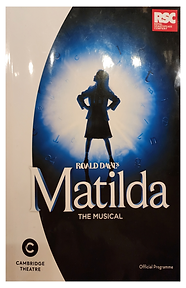
My original program book photo, included for archival purposes only
Premiere and My Visits
World Premiere :
2010
Year(s) Attended:
2026
Performance Venue:
Cambridge Theatre
Production:
West End
REVIEW
I read the synopsis of Matilda before coming to London. I started listening to a few songs on YouTube, and the algorithm kept recommending more. Before long, I had become familiar with most of the score. Every song was memorable, and my expectations kept growing.
The set immediately caught my attention. Alphabet blocks and books filled the stage and extended to both sides of the auditorium. The lighting and speakers were hidden among them. Even before the performance began, the stage felt like the inside of a children's book.
There were many children in the audience. Some people left and returned during the performance. The ushers stayed busy, reminding people not to use their phones, stopping children from kicking the seats in front of them, and asking excited children to sit down. There was constant whispering and the sound of snacks being eaten, but it felt appropriate for a family show.
My third-floor balcony seat had a partially obstructed view of the front of the stage. Fortunately, the rows behind me were empty, so I could shift my position slightly to improve my view. It would have been difficult to do this in most Korean theatres, but audiences in Broadway and the West End seem much more relaxed about this.
The musical established its tone from the opening scenes. After the birthday party, Matilda's birth is introduced in "Miracle." The doctor celebrates the birth of a child, but Mr Wormwood (Neil McDermott) casually throws away his newborn baby after discovering that she is a girl. The scene was funny and uncomfortable at the same time. It immediately showed how the musical presents serious issues through exaggerated fairy-tale storytelling.
"Miracle" and "Naughty" were just as impressive as I had expected. I especially enjoyed the scene where Matilda (Bonnie Harper) talks about reading books such as Jane Eyre and Crime and Punishment, then casually quotes Charles Dickens:
"It was the best of times, it was the worst of times.“
It was so convincing that I checked afterwards whether Matilda was really supposed to be only five years old. Her intelligence and reading habits felt extraordinary for her age.
When Matilda said she had read Dostoevsky and spoke Russian, the Russian mafia leader kindly asked if she had learned Russian simply by reading books. Matilda calmly replied,
"I suppose so.“
It was not just her knowledge that stood out. It was the way she treated it as something completely ordinary.
The role of Matilda is shared by four child actors. Bonnie Harper performed on the day I attended. This rotating cast is probably one reason why the production has maintained such a high standard for nearly seventeen years. Harper handled the demanding role with ease, including the long dialogue, literary references, songs, and even the Russian lines.
Two days before the performance, I had visited the Charles Dickens Museum. I had just been telling my colleague that "It was the best of times, it was the worst of times" was one of Dickens' best-known lines. Hearing Matilda quote it naturally on stage made the moment even more enjoyable.
One of the highlights of the production was "School Song." Alphabet blocks were placed one by one into the school gate as the song followed the alphabet from A onwards. It showed careful writing and staging. I also liked how the lyrics naturally reached "Why?", and how the difficult letter Z was cleverly resolved with "Phys-Ed.“
Another memorable number was "When I Grow Up." The children sang while swinging on large swings, creating one of the most beautiful images in the show. Looking more closely, I noticed that the performers lay flat on the stage whenever the swings crossed, carefully avoiding any collision. Seeing the precise stage management behind such a simple-looking scene made me appreciate it even more.
The children's ensemble was excellent. At first, only the children sang. Later, adult ensemble members appeared in the same school uniforms and added fuller harmonies. I initially thought they were meant to be older students mentioned earlier in the show, but they were actually adult performers doubling as students. This worked particularly well in "Revolting Children." The number began with only the children, then gradually expanded as the adults joined in. The added voices strengthened not only the sound but also the feeling of resistance. It was a very effective staging choice.
Matilda's parents were almost unbelievably terrible. They did far more than neglect their daughter because she was a girl. They actively made her life worse. Watching them, I could not help thinking that some children in real life grow up in even more difficult situations.
Near the end of the show, Matilda saves her father's life by helping him escape from the Russian mafia. Only then does he finally call her "my daughter." It was a meaningful change, even if it came far too late. Matilda's quiet expression at that moment stayed with me long after the performance.
Mrs Wormwood (Tiffany Graves) and Rudolpho received one of the strongest audience reactions with "Loud." Rudolpho's athletic stage presence and Tiffany Graves' energetic Latin dancing made the number highly entertaining. Miss Honey (Eve Norris) unexpectedly joined the dance as well, adding another enjoyable moment.
There was nothing wrong with Mrs Wormwood wanting to dance, dress well, and pursue her own happiness. Everyone has the right to live the life they want within the limits of law and morality. What could not be excused was the way she neglected and abused her young daughter. The musical made the audience laugh through exaggerated comedy, but it never lost sight of the damage caused by indifferent parents.
Miss Trunchbull (Jon Robyns) was an entertaining villain. She ruled the school through fear and constantly threatened the children with the Chokey. However, seeing Jon Robyns in the role felt strange. I had been previously watched him on Youtube as the Phantom and as Valjean. Now I found myself cheering for the same actor as he terrorized children on stage. It felt slightly contradictory. Even so, his commanding stage presence made Miss Trunchbull one of the most memorable characters in the production. Her final defeat, driven away by Matilda's powers and the children, was satisfying. At the same time, it reminded me that the show was coming to an end.
Miss Honey (Eve Norris) portrayed the character with a warm, clear voice. Despite living in fear for many years, she did not lose her kindness. She treasured the freedom of having a small home of her own and found the courage to stand up to Miss Trunchbull for Matilda's education. Her quiet resilience left a strong impression.
Her performance of "My House" was especially moving. When Matilda innocently asked, "Are you poor?“ Miss Honey simply replied, "Yes, I am.“
She was grateful to have a place of her own, however small. It was a small house, but it was the first place where she could finally feel safe. Inviting Matilda inside also felt like a promise that she would protect and care for her from then on. Rather than being a song about poverty, it felt like a song about freedom, safety, and hope.
Mrs Phelps was Matilda's closest friend before Miss Honey entered her life. Throughout the musical, the library was more than just a place to read. It was where Matilda could escape reality, use her imagination, and spend time with the only adult who truly listened to her. Like the stage itself, which was filled with books and alphabet blocks, books remained at the centre of the story.
At first, I assumed that Matilda's story about the escapologist and the acrobat was simply a product of her imagination. As the musical progressed, however, it became clear that it was actually her reconstruction of Miss Honey's family history.
The turning point came when Miss Honey said,
"My father was an es...“
and Matilda quietly completed the sentence,
"Escapologist.“
When Miss Honey continued,
"And my mother was...“
Matilda answered,
"An acrobat.“
At that moment, the circus story that had appeared throughout the show finally came together. I immediately understood why the musical had devoted so much time to it.
The scene also revealed Matilda's remarkable reasoning skills. She was not simply imaginative. She was able to connect scattered clues into a coherent story. When she immediately suggested checking the will and taking legal action, it became clear that she solved problems through logic as much as through intelligence. Her special gift was not just telekinesis.
The telekinesis itself was more restrained than I had expected. What impressed me more was Miss Trunchbull's reaction after realizing that her past crimes had been exposed. Rather than defeating the villain through supernatural power alone, the story felt as though the truth itself had finally caught up with her.
One question stayed with me after the performance. Matilda's small acts of revenge—using hair dye and superglue—were all directed at her father. Her mother neglected her just as much, while her father praised her brother despite his laziness and dismissed Matilda completely. Perhaps her father became the main target because he openly rejected her love of books and denied her worth more directly. Even so, I found myself wondering why her anger was directed almost entirely at him.
Overall, Matilda featured an outstanding cast. The child actors, principal cast, and adult ensemble all sang exceptionally well, and the sound was consistently clear. The story combined imagination with reality as Matilda solved problems, helped Miss Honey, and eventually found the family she deserved.
More than anything, the musical reminded me of the power of a strong score. The story and staging were excellent, but songs such as "Miracle," "Naughty," "School Song," "When I Grow Up," "Revolting Children," and "My House" carried the production from beginning to end. Great songs help a musical endure, attract outstanding performers, and support productions of this quality. This performance was another reminder of that.
All photos in this gallery were taken personally when photography was allowed, or are of programs, tickets, and souvenirs in my collection.


