top of page


사랑했어요
I Loved You (사랑했어요) is a Korean jukebox musical built from the songs of singer-songwriter Kim Hyun-sik, telling a tragic love story across time, memory, and separation. It combines nostalgic music with a layered narrative of love, sacrifice, and longing spanning decades.
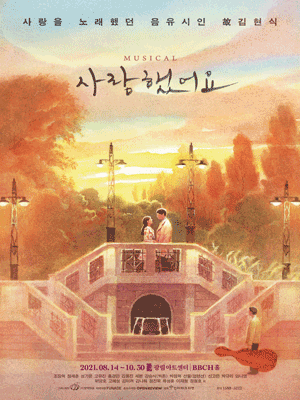
Posters included in this archive are embedded solely for documentary and educational purposes.
🔗 All images are linked to their original sources or articles. No copyright ownership is claimed.
SOURCE
jukebox
SETTING
Korea
BOOK
original
Productions in Korea (🔴 = Seoul Large Theatre Production)
2019.09 Seongnam Arts Center Opera House (Seongnam)
2021.08 🔴 Kwanglim Arts Center BBCH Hall (Seoul)
SYNOPSIS
(Full Synopsis)
Set in the present and 25 years earlier, the musical unfolds between Vienna and Korea, where a singer-songwriter revisits a past love and a tragic triangle shaped by fate, politics, and sacrifice.
In the present day, a now-famous singer-songwriter performs annually in Vienna. During one such performance, a mysterious young woman appears, asking about a woman from his past. This encounter triggers a return to his youth, when he studied music in Vienna.
As a talented but emotionally inexperienced young musician, he meets a gifted cellist at a music academy. Their shared passion for music leads to a deep and mutual love. Soon after, his close friend and benefactor arrives in Vienna, and he too falls in love with the same woman, forming a tense and unspoken love triangle.
Their relationship unfolds against a politically charged backdrop, as the woman is secretly under surveillance due to her ties to North Korea. As their emotional bonds deepen, the external pressures surrounding her identity and family begin to intrude upon their lives.
A turning point occurs when a violent confrontation involving political agents leads to a tragic incident. In the aftermath, the friend takes responsibility to protect the others, resulting in separation: the protagonist returns to Korea, the woman is taken back to the North, and the friend disappears into a life defined by sacrifice.
Years later, the protagonist becomes a successful musician, channeling his longing into music. The truth of the past gradually unfolds through letters, memories, and revelations brought by the younger generation. It is revealed that the friend endured suffering and ultimately sacrificed his life to protect both the woman and her child.
In the final moments, past and present converge through music, as the protagonist confronts his unresolved emotions. The story closes on a bittersweet note, affirming enduring love across time, loss, and memory.
PRODUCTION NOTE
I Loved You is a jukebox musical based on the songs of legendary Korean singer-songwriter Kim Hyun-sik, whose music defined the emotional landscape of the 1980s and early 1990s. The production reinterprets his iconic songs within a newly constructed narrative centered on love, memory, and separation. Featuring a creative team including director Jung Tae-young and music director Won Mi-sol, the musical combines nostalgic melodies with contemporary staging to appeal to a wide audience.


REFERENCES
Synopsis Sources
NamuWiki Synopsis – 사랑했어요
https://namu.wiki/w/%EC%82%AC%EB%9E%91%ED%96%88%EC%96%B4%EC%9A%94(%EB%AE%A4%EC%A7%80%EC%BB%AC)
Articles & Reviews
Hankyung Money – 사랑 이야기 창작뮤지컬 사랑했어요
https://magazine.hankyung.com/money/article/202101203853c
Dailian Review – 세 남녀의 사랑 이야기
https://www.dailiang.co.kr/news/articleView.html?idxno=201878
DongA – 김현식의 숨결이 살아 있는 사랑했어요
https://www.donga.com/news/Culture/article/all/20190927/97620835/2
bottom of page