

웃는 남자
The Man Who Laughs (웃는 남자) is a large-scale Korean original musical based on Victor Hugo’s novel, depicting a disfigured man’s tragic life while critiquing social inequality and aristocratic corruption in 17th-century England.
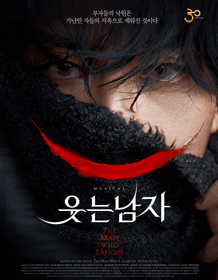
Posters included in this archive are embedded solely for documentary and educational purposes.
🔗 All images are linked to their original sources or articles. No copyright ownership is claimed.
SOURCE
novel
SETTING
Foreign
BOOK
adaptation
Productions in Korea (🔴 = Seoul Large Theatre Production)
2018.07 🔴 Seoul Arts Center Opera House (Seoul)
2018.09 🔴 Blue Square Interpark Hall (Seoul)
2020.01 🔴 Seoul Arts Center Opera House (Seoul)
2022.06 🔴 Sejong Center for the Performing Arts (Seoul)
2025.01 🔴 Seoul Arts Center Opera House (Seoul)
SYNOPSIS
(Full Synopsis)
Set in late 17th to early 18th-century England, the musical unfolds across coastal regions and London, where a man disfigured by aristocratic cruelty struggles between identity, love, and social justice.
As a child, Gwynplaine is kidnapped by a group of traffickers who mutilate children to sell them as curiosities to the nobility. His mouth is grotesquely carved into a permanent smile before he is abandoned during a storm. Wandering alone, he rescues a blind infant girl, Dea, and is taken in by Ursus, a cynical yet compassionate traveling philosopher and showman. Together, they form a small troupe, using Gwynplaine’s appearance and Dea’s innocence to survive through performance.
Years later, Gwynplaine becomes a famous traveling performer. Despite his fame, he lives modestly with Ursus and Dea, who has grown into a gentle young woman deeply devoted to him. Their relationship develops into mutual love, grounded in emotional sincerity rather than social status.
Gwynplaine’s life changes when Duchess Josiana, captivated by his unusual appearance, becomes fascinated with him and attempts to draw him into aristocratic society. At the same time, he is forcibly taken to a royal court where his hidden identity is revealed: he is actually the rightful heir to a noble title, separated from his lineage as a child through political conspiracy.
Suddenly elevated into the aristocracy, Gwynplaine is torn between two worlds. He gains wealth and status but becomes increasingly aware of the hypocrisy and cruelty of the ruling class. Rejecting their values, he speaks out in Parliament, condemning the social system that exploits the poor and marginalized. His plea for justice is met with ridicule, reinforcing his alienation.
Meanwhile, Dea, believing Gwynplaine to be dead due to deception and separation, falls gravely ill. When Gwynplaine abandons his title and returns to her, they are briefly reunited. However, Dea dies in his arms, unable to survive the emotional and physical strain.
Overcome with grief and disillusionment, Gwynplaine chooses to follow her in death, walking into the sea with her body. His tragic journey ends as a final rejection of a world built on inequality, leaving behind a powerful indictment of social injustice and a testament to enduring love.
PRODUCTION NOTE
The musical was produced by EMK Musical Company as its second original production following Mata Hari. Based on Victor Hugo’s novel L’Homme qui rit, it features music by Frank Wildhorn, lyrics by Jack Murphy, and direction by Robert Johanson. Developed over approximately five years with a large-scale budget, the production premiered in 2018 at the Seoul Arts Center Opera House and established itself as a flagship Korean musical with cinematic staging and international ambitions.


REFERENCES
Synopsis Sources
NamuWiki Synopsis
https://namu.wiki/w/%EC%9B%83%EB%8A%94%20%EB%82%A8%EC%9E%90(%EB%AE%A4%EC%A7%80%EC%BB%AC)
Wikipedia Summary
https://ko.wikipedia.org/wiki/%EC%9B%83%EB%8A%94_%EB%82%A8%EC%9E%90_(%EB%AE%A4%EC%A7%80%EC%BB%AC)
Articles & Reviews
Khan Review – Stage and Theme Analysis
https://www.khan.co.kr/article/202207031709001
MK Review – Human Dignity Theme
https://www.mk.co.kr/news/culture/11228857
Related Pages (Musicals of Korea)
The Man Who Laughs – Japan Production (2019)
https://www.musicalsofkorea.com/k-musicals-worldwide-non-english/201904-the-man-who-laughs-jp