top of page

Bballae
빨래
Official English Title

Other Titles: Laundry
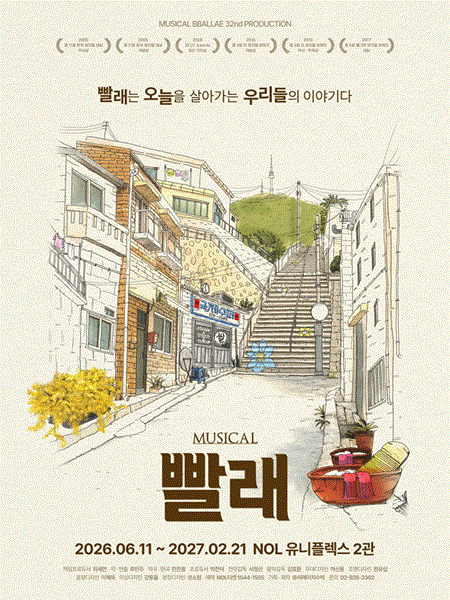
Posters included in this archive are embedded solely for documentary and educational purposes.
🔗 All images are linked to their original sources or articles. No copyright ownership is claimed.
SOURCE
original
SETTING
Korea
BOOK
original
Love and laundry in a Seoul neighborhood
Korean Premiere
2005
Korean Premiere Theatre
Byeoloreum Theater, National Theater of Korea, Seoul
Further Korean run reference:
https://namu.wiki/w/%EB%B9%A8%EB%9E%98(%EB%AE%A4%EC%A7%80%EC%BB%AC)
The Musical search cue — “빨래 뮤지컬”
Summary
A landmark Korean musical about Na-young and Solongo, a migrant worker from Mongolia, whose romance unfolds amid the hardships, solidarity, and quiet hopes of their Seoul neighbors.
Origin & Development
Laundry began as a graduation project at the Korea National University of Arts, written and directed by Choo Min-joo with music by Min Chan-hong, and produced by theatre company Myunglang Theatre Subak. It is often cited as a fully original Korean musical that sustained a long commercial run in Daehak-ro's small-theatre market. 2005 – World premiere, National Theater Company of Korea. 2005–ongoing – Long-run Daehak-ro production exceeding 3,000 performances and 500,000 cumulative audience members.
Awards include Korea Musical Awards (Best Lyrics, Best Script, 2005) and The Musical Awards (Best Lyrics, Best Composition, Best Script, 2010). Major cast alumni include Im Chang-jung, Hong Kwang-ho, Kwak Sun-young, Kim Jae-bum, and many others.
Full Synopsis
Laundry follows working-class neighbors living in a poor hillside neighborhood in Seoul. Nayoung, 27, moved to the city five years earlier, hoping to save money and attend college. Instead, she lives in a cramped rented room and works at a bookstore where she faces an abusive employer.
Her neighbor Solongo came from Mongolia after studying Russian literature in Ulaanbaatar. Now an undocumented factory worker, he supports his family and younger brother while enduring withheld wages, racist abuse, and threats of deportation. He fell in love with Nayoung when she first moved in but has struggled to approach her. Their adjacent rooftops and laundry lines gradually bring them together.
After Nayoung protests the unfair dismissal of a colleague who exposed accounting irregularities, she is transferred to a remote warehouse. Returning home drunk and distraught, she finally lowers her guard with Solongo. When his landlord attacks him, Solongo silently endures the violence rather than risk police attention and deportation. His quiet sacrifice deepens their bond.
Nayoung also finds support from her sharp-tongued but compassionate landlady, who cares for a severely disabled daughter, and from another tenant known as Heejung’s mother. When the daughter falls ill, the neighbors help take her to hospital. The following day, the women share their fears and disappointments, comforting one another with the hope that tears, like freshly washed clothes, can dry in the sunlight.
Their solidarity slowly changes the neighborhood. Heejung’s mother finds a new home, while the landlady and her daughter reunite with her estranged son. Nayoung chooses to build a life with Solongo, who finally speaks a word he never learned amid the insults of the factory: love.

パルレ
2012
2012-02-17
to
2012-02-18
Country:
Japan
City:
Multiple Cities
Production Type:
Licensed

Language:
Japanese
Venue:
Multiple Venues
Featuring an all-Japanese cast with Kimura Hanayo as Na-young, the production was introduced as the title's first licensed export. Press described it as portraying bright but struggling lives in Seoul's back alleys, while marketing echoed the down-to-earth tone of the original Korean staging.
It played Zepp Blue Theater Roppongi in Tokyo and Sankei Hall Breeze in Osaka.

洗衣服
2016
2016-08-19
to
2016-09-04
Country:
China
City:
Multiple Cities
Production Type:
Full Production

Language:
Korean
Venue:
Multiple Venues
Performed by the original Korean cast with full Korean staging, music, and direction and Chinese surtitles, the production opened at Shanghai Dramatic Arts Center in January 2016 and relaunched as a national tour from Beijing Tianqiao Art Center, continuing to Qingdao, Guangzhou, Shenzhen, and other cities for more than 30 performances. Chinese press highlighted its realism, multicultural cast, and reputation as 'the hope of original Korean musicals'.
bottom of page