top of page

Gwanghwamun Love Song 2
광화문연가2
Literal Translation

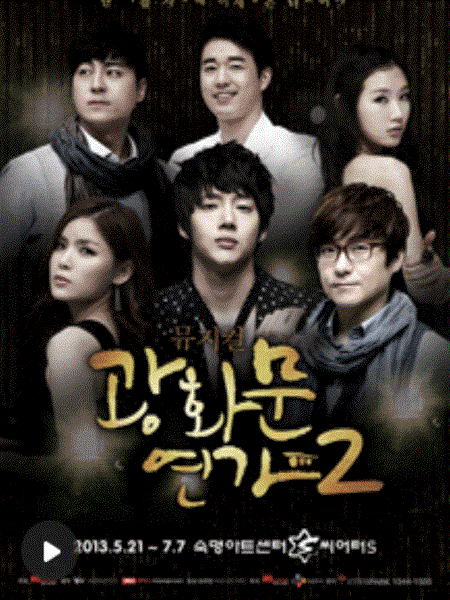
Posters included in this archive are embedded solely for documentary and educational purposes.
🔗 All images are linked to their original sources or articles. No copyright ownership is claimed.
SOURCE
jukebox
SETTING
Korea
BOOK
original
A sequel built on Lee Young-hoon's songs
Korean Premiere
2013
Korean Premiere Theatre
Theater S, Sookmyung Art Center, Seoul
Further Korean run reference: https://www.themusical.co.kr/Musical/Detail?num=1970
The Musical search cue — “광화문연가2”
Summary
A concert-style sequel musical built around the songs of the late composer Lee Young-hoon, premiered in Seoul in 2013.
Origin & Development
Premiered in 2013 at Sookmyung Art Center Theater S, produced by Musical Service. Conceived as a spin-off of the 2011 musical but rewritten in a new format, the show adapts Lee Young-hoon’s songs into a meta-narrative about idol culture, fandom, and the economics of the music industry. It was promoted as a “K-concert musical,” foregrounding a live 8-piece band onstage rather than a traditional book-musical staging. (Not to be confused with CJ ENM’s unrelated 2017 musical of the same title.) 2013 – Seoul Premiere. 2013.05.17 – 07.07, Sookmyung Art Center Theater S. Directed by Kim Kyu-jong, music arranged by Oh Sang-jun, featuring an onstage 8-member band.
Marketed as a “concert musical” rather than a narrative continuation of the 2011 production. (No additional Korean remounts recorded; the title does not return after its China tour.).
Partial Synopsis
Adam, a reigning idol, Sanha, a faded former star, and Gaeul, a singer turned girl-group member, are unexpectedly booked for the same concert. Rehearsals revive rivalry, nostalgia, and unresolved relationships among them.

光华门恋歌·第二季
2013
2013-11-02
to
2013-11-16
Country:
China
City:
Multiple Cities
Production Type:
Full Production

Language:
Korean
Venue:
Multiple Venues
Presented by Musical Service with local Chinese presenters, the tour gave ten performances in four cities: Shanghai, Hangzhou, Nanchang, and Fuzhou. It was invited as the opening production of China's first International Musical Festival in Hangzhou, and Chinese press emphasized its open band set, LED-driven visuals, and pop-concert pacing in contrast to traditional operatic musical formats. The production later expanded into a long-run multi-city contract and was cited in Korean media as an early commercial success for Korean jukebox musicals in mainland China.
bottom of page