top of page

Singles
싱글즈
Official English Title

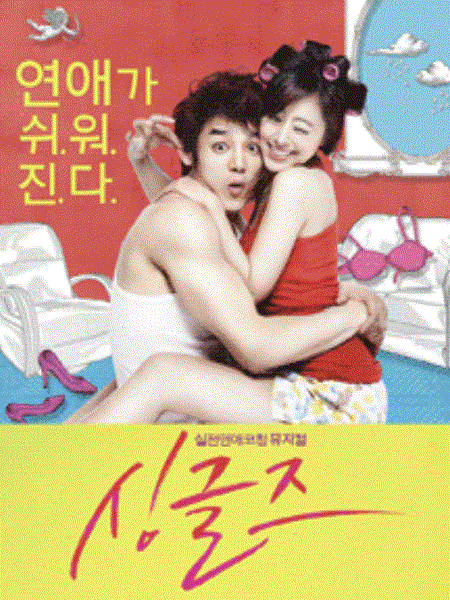
Posters included in this archive are embedded solely for documentary and educational purposes.
🔗 All images are linked to their original sources or articles. No copyright ownership is claimed.
SOURCE
film
SETTING
Korea
BOOK
adaptation
Based on the 2003 film Singles
Korean Premiere
2007
Korean Premiere Theatre
Dongsoong Art Center Arthall, Seoul
Further Korean run reference:
https://ko.wikipedia.org/wiki/%EC%8B%B1%EA%B8%80%EC%A6%88_(%EB%AE%A4%EC%A7%80%EC%BB%AC)
https://www.themusical.co.kr/Musical/Detail?num=1964
The Musical search cue — “싱글즈 뮤지컬”
Summary
A romantic comedy musical adapted from the 2003 Korean film Singles, portraying the work, love, and identity struggles of 29-year-olds on the brink of turning 30.
Origin & Development
2007, produced by Akom Company, based on the Korean film “Singles” (itself adapted from the Japanese drama “29-Year-Old Christmas”). Book by Hwang Seong-u and music by Jang So-young. Created as a contemporary, character-centered musical about careers, breakup recovery, late-20s anxiety, and chosen family. Quickly gained popularity among young adult audiences, becoming a rare Korean original musical with sustained commercial appeal. 2007 – Premiere, Dongsoong Art Center (Seoul). 2008–2013 – Recurring Daehangno and touring seasons, total of 26 runs nationwide, winner of 2008 Korea Musical Awards Best Original Musical.
Partial Synopsis
Nan-nan approaches her 30th birthday while juggling job insecurity, romance, and social pressure. Her best friend Dong-mi appears self-assured but secretly questions her own life choices, while landlord and roommate Jeong-joon complicates matters when an accidental night together changes their dynamic. The show blends comedy, urban realism, and heartfelt pop-ballad numbers, exploring the fear and freedom of entering one’s thirties.

シングルズ
2013
2013-05-24
to
2013-06-16
Country:
Japan
City:
Tokyo
Production Type:
Licensed

Language:
Korean
Venue:
Amuse Musical Theatre
Presented in parallel with the Seoul production at SM Art Hall, with the full Korean cast alternating between Tokyo and Seoul and identical staging and direction. The Tokyo engagement recorded over 70% attendance and drew positive press for its relatable 'turning 30' theme and the cast's use of Japanese in audience-participation scenes.
bottom of page