top of page

The Man Who Laughs
웃는 남자
Official English Title

Other Titles: 웃는남자
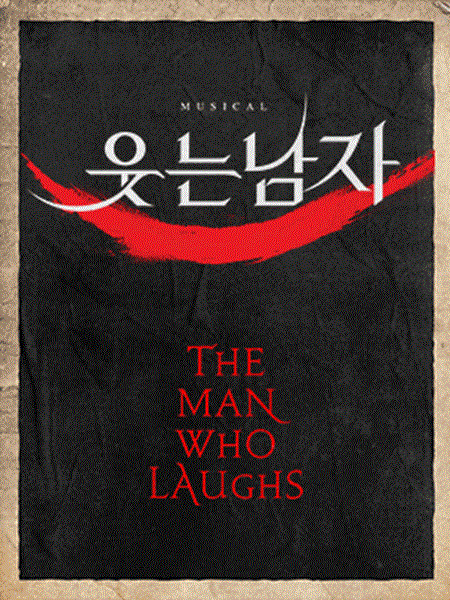
Posters included in this archive are embedded solely for documentary and educational purposes.
🔗 All images are linked to their original sources or articles. No copyright ownership is claimed.
SOURCE
novel
SETTING
Foreign
BOOK
adaptation
Based on Victor Hugo, The Man Who Laughs
Korean Premiere
2018
Korean Premiere Theatre
Seoul Arts Center, Opera Theatre, Seoul
Further Korean run reference:
https://namu.wiki/w/%EC%9B%83%EB%8A%94%20%EB%82%A8%EC%9E%90(%EB%AE%A4%EC%A7%80%EC%BB%AC)
The Musical search cue — “웃는 남자 뮤지컬”
Summary
Gwynplaine, disfigured into a permanent smile and displayed as a spectacle, is pulled between love, aristocratic power, and the brutal inequality of society.
Origin & Development
2018 – EMK Musical Company (Seoul, Korea) Based on Victor Hugo’s novel L’Homme qui rit, with music by Frank Wildhorn, lyrics by Jack Murphy, book and direction by Robert Johanson. Conceived as EMK’s second original title after Mata Hari, the production was developed over five years with a reported budget of 17.5 billion KRW.
The world premiere took place at the Seoul Arts Center Opera House, establishing the work as a flagship large-scale musical with cinematic scenography and star casting. 2018 premiere – Seoul Arts Center Opera House (preview July 8; official run July 10–Aug 26). 2018 extension – Blue Square Interpark Hall (Sept 5–Nov 4). 2020 revival – Seoul Arts Center Opera House (Jan 9–Mar 1). 2022 third run – Sejong Center Grand Theater (Jun 10–Aug 22). 2025 fourth run – Seoul Arts Center Opera House (Jan–Mar 2025).
Notable for star casting across multiple seasons including Park Hyo-shin, Park Eun-tae, and Kang-hyun Park, the show quickly became a commercial hit and an anchor title in EMK’s original-musical portfolio.
Partial Synopsis
Set in 17th-century England, the story follows Gwynplaine, a boy disfigured by child traffickers and abandoned in a snowstorm, who later becomes a famed sideshow performer. Raised alongside the blind girl Dea by traveling showman Ursus, he struggles between a life of anonymity and sudden elevation into the aristocracy when his true heritage is revealed. Themes of class, fate, spectacle, and moral corruption drive the narrative, underscored by a dark romantic tone and Wildhorn’s characteristic pop-orchestral score. The musical blends gothic imagery with political melodrama, ending in tragedy rather than restoration.

笑う男
2019
2019-04-09
to
2019-04-29
Country:
Japan
City:
Tokyo
Production Type:
Licensed

Language:
Japanese
Venue:
Nissay Theatre
The musical’s first overseas license, directed and translated by Kazutoshi Ueda with an all-local cast and starring Kenji Urai as Gwynplaine. Toho redesigned about half of the original Korean set to fit Japanese venues while keeping the core score and staging vocabulary, and the production toured Aichi, Toyama, Osaka, and Fukuoka with press attention to its scale.

笑う男
2022
2022-02-03
to
2022-02-19
Country:
Japan
City:
Tokyo
Production Type:
Licensed
Language:
Japanese
Venue:
Imperial Theatre
Toho's renewed staging, marketed as a 'newly renovated version' with updated design, followed Tokyo with runs in Osaka (Umeda Arts Theater) and Fukuoka (Hakataza Theater). It continued Toho's strategy of positioning the musical alongside Western imports such as Les Misérables and Elisabeth, reinforcing the title as a repeatable international property.
bottom of page